SMART Recovery: The 4-Point Program, Tools, and How It Works
SMART Recovery is an organization that provides support for people recovering from drug, alcohol, or behavioral addictions by using scientific evidence practices, teaching coping tools, and encouraging people’s motivation to create positive changes that promote sobriety.


Key Takeaways
- SMART Recovery stands for Self-Management and Recovery Training. It is a free, secular support program for people who want to change alcohol use, drug use, gambling, or other addictive behaviors.
- SMART Recovery uses a 4-Point Program. It helps people build motivation, cope with urges, manage thoughts and behaviors, and create a more balanced life.
- The program teaches practical, evidence-informed tools. Exercises based on CBT and REBT help participants question harmful thoughts, understand triggers, and respond to cravings in safer ways.
- SMART Recovery is different from AA and NA. It does not require belief in a Higher Power, does not use the 12 Steps, and does not ask participants to identify themselves by addiction.
- SMART Recovery can support recovery, but it is not medical treatment. People at risk for withdrawal, relapse, or co-occurring mental health conditions may also need medical detox, therapy, medication, or structured addiction treatment.
SMART Recovery is a free, secular support program for people who want to change addictive behaviors. SMART stands for Self-Management and Recovery Training. Instead of using the 12 steps, the program teaches practical skills to manage cravings, challenge unhelpful thoughts, strengthen motivation, and build a more balanced life.
SMART Recovery is an evidence-informed program grounded in cognitive behavioral therapy (CBT) and rational emotive behavior therapy (REBT). Meetings are led by trained facilitators and are available for people affected by alcohol, drugs, gambling, and other addictive behaviors.
In this guide, we explain SMART Recovery’s 4-Point Program, the tools used in meetings, what a meeting is like, and how SMART Recovery compares with Alcoholics Anonymous (AA). We also review what research says about mutual-support programs so you can better understand whether this approach may fit your needs or those of someone you love.
What Is SMART Recovery?
SMART Recovery is a secular mutual-support program that helps people change addictive behaviors through practical skills and peer support. It focuses on change, not identity.
SMART also puts responsibility in the hands of the person working toward recovery. That does not mean doing everything alone. In meetings, people can discuss setbacks, learn from others, and practice ways to respond to cravings, stress, and difficult emotions.
SMART Recovery is not medical detox, therapy, or a rehab program. For some people, especially those at risk for withdrawal or relapse, SMART works best as part of a larger plan that may include medical detox, residential treatment, outpatient care, counseling, or medication for addiction treatment.
History of SMART Recovery
SMART Recovery became an official nonprofit program in 1994, but its roots go back to the secular recovery movement of the 1980s. It grew out of a need for addiction support that focused on science, self-management, and practical behavior change.
For many years, Alcoholics Anonymous (AA) and other 12-step groups were the most recognized recovery support options. Many people still find AA helpful. But some people wanted a different kind of support. They did not connect with the focus on a higher power. Others struggled with the idea that they were powerless over alcohol or drugs.
In 1985, Jack Trimpey founded Rational Recovery. The program focused on self-reliance, personal choice, and changing addictive behavior through practical thinking tools. Rational Recovery grew during the late 1980s and early 1990s.
SMART Recovery later developed as its own nonprofit organization in 1994. The program kept its evidence-informed focus but built a separate structure around self-management, trained facilitators, and practical recovery tools.
Since then, SMART Recovery has continued to grow. The organization says it started with about 42 meetings and now has more than 1,500 meetings in the United States. SMART meetings are also available in more than 20 countries.
The SMART Recovery 4-Point Program
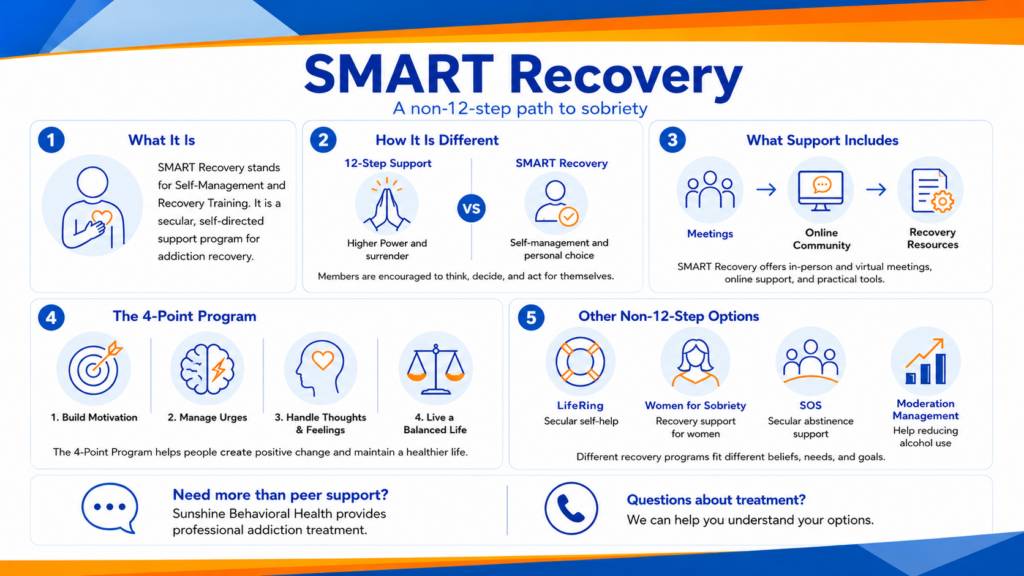
The SMART Recovery 4-Point Program focuses on four areas: motivation, urges, thoughts and behaviors, and a balanced life. These points help people understand what drives addictive behavior and practice new ways to respond.
Unlike the twelve steps used in Alcoholics Anonymous (AA), SMART’s four points are not meant to be completed in order. A person may work on more than one point at the same time. They may also return to a point when cravings, stress, or setbacks become difficult.
1. Build and Maintain Motivation
Change often starts with a personal reason. You may want better health, stronger relationships, more stability, or freedom from the effects of alcohol or drugs.
SMART Recovery helps you identify your reasons for change and keep them visible. This can be helpful when motivation drops or using alcohol or drugs starts to feel tempting again.
2. Cope With Urges
Cravings can feel strong, but they do not last forever. SMART Recovery teaches people to notice triggers, understand urges, and use coping skills instead of acting on a craving.
A trigger may be a stressful day, a certain person, a place, or a painful emotion. Learning what triggers an urge can make it easier to prepare for it.
3. Manage Thoughts, Feelings, and Behaviors
Thoughts and emotions can affect the choices people make. For example, someone may think, “I already messed up, so there is no point in trying.” That thought can make continued substance use feel more likely.
SMART Recovery helps people question thoughts that lead to harmful behavior. It also teaches healthier ways to respond to anger, anxiety, guilt, sadness, and stress.
4. Live a Balanced Life
Recovery involves more than avoiding alcohol, drugs, or another addictive behavior. It also means building a life that supports your goals and well-being.
This may include healthy routines, supportive relationships, work or school goals, hobbies, sleep, physical health, and time for rest. A balanced life can make recovery feel more meaningful and easier to maintain.
SMART Recovery uses tools grounded in cognitive behavioral therapy, or CBT. CBT helps people see how thoughts, feelings, and actions affect each other.
Is SMART for You?
People might have different needs and preferences, so they might want to learn about SMART Recovery, 12-step groups, and other options and attend their meetings to discover what works for them. Some people have even found that belonging to multiple organizations helps them maintain their sobriety.
If people aren’t religious or are wary of religion, they might prefer SMART Recovery. People who are looking for scientific, evidence-based treatment options might prefer that organization over groups that emphasize spirituality.
The principles of SMART Recovery don’t differentiate among addictions. The organization applies similar principles to help treat people whether they’re addicted to alcohol, drugs, or specific behaviors. On the other hand, many 12-step groups focus on one addiction: Alcoholics Anonymous helps people with addictions, while Over Eaters Anonymous assists people with problems related to eating and food, and so on.
Neither approach is right or wrong, it’s just that some people might be more comfortable with certain approaches.
Are alcohol and drugs ruining your life?
Find help nowThe Stages of Change Model in SMART Recovery
SMART Recovery recognizes that people do not change addictive behavior all at once. Some people are ready to stop using. Others are still deciding whether change is necessary. The program uses the Stages of Change Model, also called the Transtheoretical Model, to help people understand where they are and what support may help next.
The model includes five stages:
- Precontemplation: The person may not see the behavior as a problem yet. Family members or loved ones may be more concerned than they are.
- Contemplation: The person starts to think about change. They may see the harm caused by alcohol, drugs, or another behavior, but still feel unsure.
- Preparation: The person begins making a plan. They may look for meetings, talk with a treatment provider, set a goal, or decide what they want to change first.
- Action: The person starts making changes. They may attend SMART Recovery meetings, use coping tools, stop using substances, or begin professional treatment.
- Maintenance: The person works to protect their progress. They keep using support, routines, and coping skills to reduce the risk of relapse.
These stages do not always happen in a straight line. A person may move forward, have a setback, and return to an earlier stage. SMART Recovery treats that as a chance to learn what happened and choose a safer response next time.
SMART Recovery Tools and Techniques
SMART Recovery uses practical worksheets and exercises to help people apply the 4-Point Program in daily life. These tools can help you understand a craving, question a harmful thought, strengthen your motivation, or plan your next step.
One reason people like SMART Recovery is that it gives them something to do. The tools are not abstract advice. They are simple exercises you can use when a craving hits, when emotions feel strong, or when old thinking patterns show up.
|
Tool |
What it helps you do |
Point it supports |
|
ABC Exercise |
Break down an event, the belief that follows it, and the result of that belief. |
Managing thoughts, feelings, and behaviors |
|
Cost Benefit Analysis (CBA) |
Compare what an addictive behavior gives you with what it costs over time. |
Building and maintaining motivation |
|
DENTS |
Use five ways to manage an urge: Deny or Delay, Escape, Neutralize, Tasks, and Swap. |
Coping with urges and cravings |
|
Personify and Disarm |
Treat an urge as separate from you, so you can respond without obeying it. |
Coping with urges and cravings |
|
Define Your Values |
Identify what matters most to you and connect change to those priorities. |
Building and maintaining motivation |
|
Create a Change Plan |
Turn a goal into clear actions, support, and signs of progress. |
Living a balanced life |
The ABC Exercise is one of the most common SMART tools. It helps you slow down and look at what happens between a stressful event and the choice to use alcohol, drugs, or another addictive behavior.
For example, you may have a painful call with a family member. That is the activating event. Then you may think, “I cannot handle this without a drink.” That is the belief. The consequence may be drinking, isolating, or giving up on your recovery goal for the day.
The ABC Exercise helps you catch that middle step. Instead of accepting the thought as true, you can question it. A more helpful thought might be: “This is painful, but drinking will create more problems. I can call someone, take a walk, or let this feeling pass.”
That does not mean the craving goes away right away. It means you have a way to respond before the craving takes over.
How SMART Recovery Meetings Work
SMART Recovery meetings are free support groups led by trained volunteer facilitators. Most meetings last about 60 to 90 minutes and are available in person or online. You do not have to speak before you feel ready, and you are not required to describe yourself with a label.
Meetings focus on discussion and practical problem-solving. Instead of listening to one person speak for the full meeting, participants may talk about current struggles, use a SMART tool, and share ideas that have helped them manage urges or change addictive behaviors.
A typical meeting may include:
- Check-in: Participants may briefly share how the past week has gone.
- Discussion: The group talks about challenges members want help with, such as cravings, motivation, or setbacks.
- Tool work: The facilitator may guide the group through a SMART Recovery tool and explain how to use it in daily life.
- Mutual support: Members can share solutions, encouragement, and lessons from their own experiences.
- Check-out: Participants may identify a goal or plan for the coming week.
Participation is voluntary. Some people speak during their first meeting. Others listen until they feel more comfortable. SMART Recovery also asks members to respect privacy, avoid judgment, and avoid detailed stories that could trigger others.
You can find both online and in-person meetings through the official SMART Recovery meeting finder. Online meetings may be easier for people who have limited transportation, busy schedules, family responsibilities, or anxiety about attending in person.
What SMART Recovery Can Help With
SMART Recovery can support people working to change substance use, behavioral addictions, or both. The same tools can apply to many problems because SMART focuses on urges, thoughts, choices, and habits.
SMART Recovery may help people dealing with:
- Alcohol use: SMART tools can help people build motivation, manage cravings, and create a plan to stay sober.
- Drug use: SMART can support people working through problems with opioids, stimulants, marijuana, prescription drugs, or other substances.
- Gambling: SMART tools can help people notice triggers, delay urges, and challenge thoughts that lead back to gambling.
- Food, shopping, gaming, or internet use: SMART may also help with compulsive behaviors that feel hard to stop.
SMART Recovery can also fit alongside treatment for co-occurring disorders. A co-occurring disorder means a person has both substance use concerns and a mental health condition, such as anxiety, depression, PTSD, or bipolar disorder.
This matters because addiction and mental health symptoms often affect each other. A person may drink to calm anxiety. Someone else may use drugs to escape depression or trauma memories. Over time, the substance use can make those symptoms worse.
Families can also use SMART-based support. SMART Recovery Family & Friends is a separate program for people who love someone with addiction. It teaches families how to communicate, set boundaries, reduce conflict, and support change without trying to control the person.
Is SMART Recovery Effective? What the Research Shows
Most of the available research on SMART Recovery focuses on alcohol use. However, the evidence available so far is encouraging.
A 2017 review published in Psychology of Addictive Behaviors looked at 12 studies on SMART Recovery. The researchers found early evidence that the program may help people with addictive behaviors, especially problems related to alcohol use. They also noted that more long-term research is needed.
Another study published in the Journal of Substance Abuse Treatment followed people with alcohol use disorder for one year. People who chose SMART Recovery had results similar to people who chose other mutual-support groups after differences in recovery goals were taken into account. This matters because it suggests that people may benefit from choosing a program that fits their beliefs and needs.
These results do not mean SMART Recovery is the right fit for everyone. They suggest that SMART may be a helpful option for people who want practical tools, personal choice, and a secular approach to recovery.
SMART Recovery vs. 12-Step Programs (AA / NA)
SMART Recovery and 12-step programs both connect people with peer support. The main difference is how each program helps people work on change.
|
Comparison |
SMART Recovery |
12-Step Programs Such as AA and NA |
|
Program structure |
Uses the 4-Point Program and related tools. |
Uses the 12 Steps. |
|
Spiritual content |
Does not require religious belief or a Higher Power. |
Uses the language of a Higher Power in the steps. |
|
How people work on change |
Focuses on self-management, urges, thoughts, and habits. |
Focuses on working the steps with support from the fellowship. |
|
Meeting support |
Meetings are guided by trained facilitators. |
Members may use sponsorship for individual support. |
|
Labels |
Does not require members to use labels. |
Members may identify themselves as “alcoholics” or “addicts.” |
For some people, the structure and spiritual language of a 12-step program feel supportive. For others, SMART’s secular approach and practical exercises feel easier to use. The goal is not to choose a “better” program. It is to find support you are willing to return to.
Is SMART Recovery Right for You?
SMART Recovery may be worth trying if its way of thinking feels natural to you. You do not have to know right away whether it will be the best fit. Attending a meeting can help you decide whether the tools, discussion style, and group support feel useful.
SMART Recovery may fit you if:
- You want to focus on choices you can make now.
- You like working through problems with practical exercises.
- You want to learn how to respond to cravings and difficult emotions.
- You prefer discussion-based meetings led by a facilitator.
- You feel more comfortable with recovery support that does not use spiritual language.
- You want a program that does not ask you to define yourself by addiction.
It may also help to ask yourself a few honest questions. Do I feel comfortable with the language used in this program? Would I attend these meetings again? Do the tools help me handle the situations that put my recovery at risk?
You do not need to make a final decision before getting support. Some people attend a SMART Recovery meeting, see how it feels, and then choose what works for them. The right support is the one that helps you keep showing up and making changes that protect your recovery.
How to Find a SMART Recovery Meeting
You can find a free SMART Recovery meeting through the official SMART Recovery Meeting Finder. The locator lists both in-person and online meetings, so you can choose the option that feels most comfortable for you.
To find a meeting:
- Search by location. Enter your city and state to find meetings near you.
- Choose in-person or online. In-person meetings offer face-to-face support. Online meetings let you attend from home and may fit more easily into your schedule.
- Review the meeting details. Check the date, time, location, and meeting type before attending.
- Attend your first meeting. You do not need to prepare anything or make a long-term commitment. You can listen and decide whether the meeting feels helpful.
SMART Recovery also offers a mobile app that gives users access to meeting information and recovery tools from their phone.
Other Non-12-Step Recovery Options
SMART Recovery is one of several non-12-step support groups. If SMART feels close to what you want, it may help to know about other secular or self-directed options.
Other non-12-step recovery options include:
- LifeRing Secular Recovery: LifeRing uses a “3-S” philosophy: sobriety, secularity, and self-empowerment. Its meetings focus on abstinence, peer support, and building a personal recovery plan without prayer or religious content.
- Women for Sobriety: Women for Sobriety offers the New Life Program, which uses 13 Acceptance Statements. The program focuses on changing negative thinking, building emotional strength, and supporting women in recovery.
- Secular Organizations for Sobriety: Secular Organizations for Sobriety, also called Save Our Selves or SOS, offers secular mutual support for people who want to achieve and maintain sobriety. SOS places sobriety as the main priority and does not require religious belief.
- Moderation Management: Moderation Management is different from abstinence-based groups. It focuses on helping people reduce drinking and change their relationship with alcohol. This may not be safe or appropriate for people with alcohol withdrawal risk, repeated loss of control, or a medical need for abstinence.
These programs show that recovery support is not one-size-fits-all. Some people need abstinence. Others are still deciding what change should look like. Some want secular support. Others want a group made for a specific need or identity.
The goal is to choose support that helps you stay honest, safe, and connected. For some people, that may be SMART Recovery. For others, another support group may feel like a better fit.
Frequently Asked Questions About SMART Recovery
What does SMART Recovery stand for?
SMART stands for Self-Management And Recovery Training. It’s an evidence-informed program that helps people change addictive substances and behaviors through practical tools and peer support.
Is SMART Recovery free?
Yes. SMART Recovery meetings are free to attend, both in person and online. Handbooks and some materials can be purchased, but they aren’t required to participate.
Is SMART Recovery religious?
No. SMART Recovery is secular and evidence-informed. It does not require belief in a Higher Power or the use of spiritual steps.
Is SMART Recovery as effective as AA?
Research on SMART Recovery is still limited. However, a one-year study found that people attending SMART had alcohol outcomes similar to people attending other mutual-support groups after researchers accounted for differences in recovery goals.
Can I attend SMART Recovery and AA at the same time?
Yes. Some people find that combining approaches — or using SMART alongside professional treatment — gives them the strongest support. There’s no rule that you have to choose just one.
Does SMART Recovery work for drug addiction?
SMART Recovery supports people working through drug use, alcohol use, and other addictive behaviors. However, most available research has focused on alcohol use. People with substance use disorders may also need professional treatment, medication, or medical support depending on their needs.
Find SMART-Informed Treatment at Sunshine Behavioral Health
SMART Recovery meetings can provide support, structure, and practical tools. But some people need more help than a peer support meeting can provide.
At Sunshine Behavioral Health, our non-12-step treatment options use evidence-based approaches, including cognitive behavioral therapy (CBT). These skills can help you identify triggers, manage cravings, challenge harmful thoughts, and build healthier ways to respond to stress.
We also provide care for people with co-occurring disorders, such as addiction with anxiety, depression, trauma, or other mental health conditions. Treating both concerns together can help you understand what is driving substance use and what support you may need.
If you are unsure whether peer support, outpatient treatment, or another level of care is right for you, our admissions team can help you understand your options. You can ask questions, verify your insurance, and talk about what is happening without pressure.
Sources


Medical disclaimer:
Sunshine Behavioral Health strives to help people who are facing substance abuse, addiction, mental health disorders, or a combination of these conditions. It does this by providing compassionate care and evidence-based content that addresses health, treatment, and recovery.
Licensed medical professionals review material we publish on our site. The material is not a substitute for qualified medical diagnoses, treatment, or advice. It should not be used to replace the suggestions of your personal physician or other health care professionals.